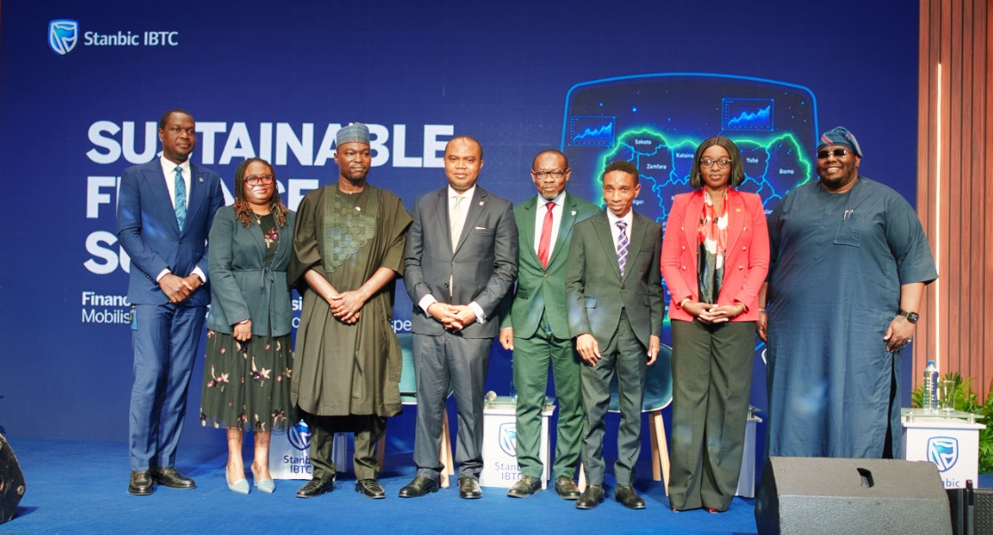
(L-R: Efe Omoduemuke – Executive Director, Stanbic IBTC Pension Managers Limited; Marilyn Obaisa-Osula, Partner, ESG, Climate and Sustainability, PwC; Mallam Ibrahim Shelleng, Senior Special Assistant to the President on Climate Finance and Stakeholder Engagement; Chuma Nwokocha, Chief Executive, Stanbic IBTC Holdings; Prof Bongo Adi, Faculty, Lagos Business School; Abraham Durosawo, Vice President, Nigeria Sovereign Investment Authority (NSIA); Barbara Izilein, Executive Director, Investments and Projects, The Infrastructure Bank (TIB); and Dr Adebola Odunsi – Chief Executive Officer, Carbonivity)
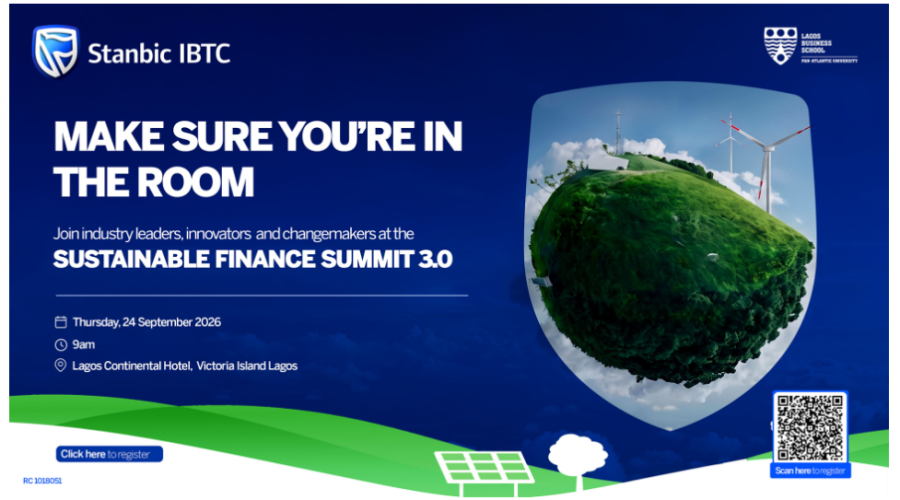
Stanbic IBTC Holdings, in partnership with the Lagos Business School (LBS) Sustainability Centre, recently delivered the Sustainable Finance Summit 3.0 in Lagos, Nigeria. It was a convening of financial market players, development sector experts, academia, and policymakers to address pathways for mobilising capital to accelerate sustainable investments and climate action that will accelerate Nigeria’s Just Transition.
Themed ‘Financing Nigeria’s Just Transition: Mobilising Capital for People, Policy and Prosperity,” the summit centered on practical frameworks for unlocking investable opportunities, navigating regulatory landscape shifts, and deploying financial innovations such as blended finance, catalytic capital and green instruments to build economic resilience.
Chuma Nwokocha, Chief Executive, Stanbic IBTC, delivered the opening remarks. He underscored Stanbic IBTC’s commitment to driving environmental, social, and economic impact. He said, “For Nigeria, a just transition and sustainable development are inseparable. We are here to steer conversations on how we can allocate capital, shape policy, drive inclusion, and build institutions capable of unlocking prosperity at scale for every Nigerian and for future generations.” He added,. “Sustainable finance is about economic resilience, value creation and inclusive growth. Our role and commitment is anchored in a simple belief that sustainable finance is not only good business but sound practice that creates long-term value for people, businesses, communities, and the economy at large.”
Speaking on behalf of the Dean, Lagos Business School, Prof. Bongo Adi, Professor of Economics and Business Intelligence, highlighted the critical need to align policy frameworks with private capital. He noted that bridging Africa’s sustainable development gap requires structured public-private partnerships (PPPs) alongside data-driven policy incentives that de-risk green investments for institutional investors. He said, “At Lagos Business School, we believe embedding sustainability in strategy, capital, risk, and operations is critical to growth and long-term value. On behalf of LBS and the LBS Sustainability Centre, we express our sincere gratitude to Stanbic IBTC Holdings for their continued partnership and steadfast commitment to advancing this critical dialogue.”
Mallam Ibrahim Shelleng, Senior Special Assistant to the President on Climate Finance and Stakeholder Engagement delivered the goodwill remarks. He said, “This summit reflects an important evolution in our national conversation. Sustainable finance is no longer a peripheral issue, but increasingly recognised as an instrument for economic diversification, infrastructure development, energy security, food security, industrial competitiveness and job creation.” He added, “The World Bank estimates that without adequate climate action, Nigeria could lose 30 percent of its GDP by 2050. Under President Bola Ahmed Tinubu, the government is building the right policy and regulatory frameworks to convert Nigeria’s climate ambitions into investment opportunities.”
The keynote speaker, Titiayo Oshodi, Special Adviser to Lagos State Governor on Climate Change and Circular Economy spoke on the topic ‘Capital Meets Climate: Financing Nigeria’s Just Transition at Scale.’ She enjoined key players to find the right data, the right policy, the right partners and the right capital to move the ecosystem forward. One high point of the event was the unveiling of the Standard Bank Group (SBG) Sustainability Academy by Chuma Nwokocha, CE, Stanbic IBTC Holdings, a learning platform to support a wide range of learners in sustainability and ESG (Environmental, Social, and Governance) knowledge across Nigeria and Africa.
The summit also featured a panel discussion on the topic ‘Unlocking and Mobilising Domestic Capital for Nigeria’s Just Transition and Sustainable Growth’ the expert panellists included Abraham Durosawo – Vice President, Nigeria Sovereign Investment Authority (NSIA); Efe Omoduemuke – Executive Director, Stanbic IBTC Pension Managers Limited; Barbara Izilein – Executive Director, Investments and Projects, The Infrastructure Bank (TIB); Dr Adebola Odunsi – Chief Executive Officer, Carbonivity; and moderated by Mrs Marilyn Obaisa-Osula, Partner, ESG, Climate and Sustainability, PwC. The session emphasised localising solutions, scaling blended finance models, and establishing transparent ESG reporting frameworks to build confidence for international and domestic investors.
In her insight presentation, Tosin Leye-Odeyemi, Head of Personal Banking, Stanbic IBTC Holdings, emphasised that sustainable finance is no longer a niche consideration but a mainstream imperative. Kola Lawal, Executive Director, Enterprise Risk, in his closing remarks gave the charge to stakeholders to move from dialogue to action. He said, “ we will continue to shape the conversation with partners like Lagos Business School and others to keep this issue at the forefront of key stakeholders, institutions and our nation as a whole. Let’s play our part, take action and plant the seeds for the future of a sustainable Nigeria.”
Reflecting on the purpose and desired impact of SFS 3.0, Orevaoghene Atanya, Director, LBS Sustainability Centre, remarked that the consensus among stakeholders at the summit pointed to an urgent mandate: building sustainability priorities into the finance ecosystem where appropriate instruments, supportive policies, and innovative financing mechanisms align to deliver projects and outcomes for a just transition for Nigeria and the Africa We Want.
Watch the video playback on youtube @Stanbic IBTC for more.
About Stanbic IBTC Holdings PLC
Stanbic IBTC Holdings PLC, a member of Standard Bank Group, is a full-service financial services provider offering end-to-end banking, wealth, and investment solutions in Nigeria, with a core commitment to driving sustainable economic growth across Africa. Email: press@stanbicibtc.com or visit www.stanbicibtc.com for more.
About Lagos Business School and Lagos Business School Sustainability Centre
Lagos Business School is Africa’s leading management education institution and the LBS Sustainability Centre is a globally recognised knowledge hub that brings together the theory and practice on business and sustainability for the advancement of business performance and development outcomes. For more information about the initiatives and upcoming events by the Lagos Business School Sustainability Centre, please contact sustainabilitycentre@lbs.edu.ng. Together we can work towards a sustainable future for businesses on the continent. See LBS programmes at https://lbssustainabilitycentre.edu.ng/training