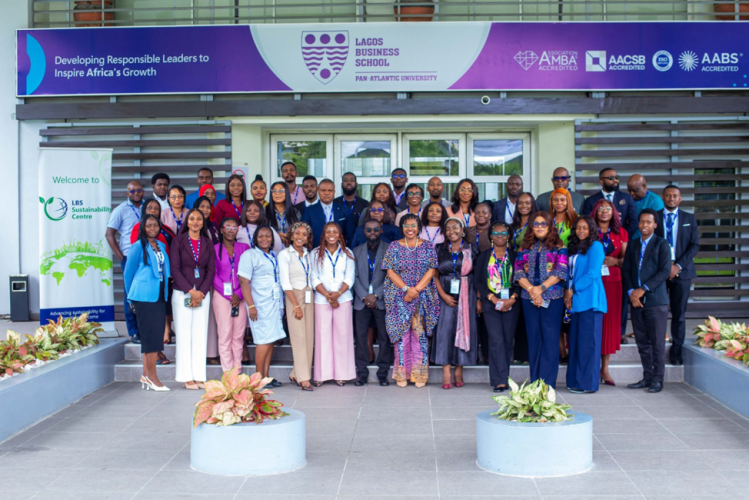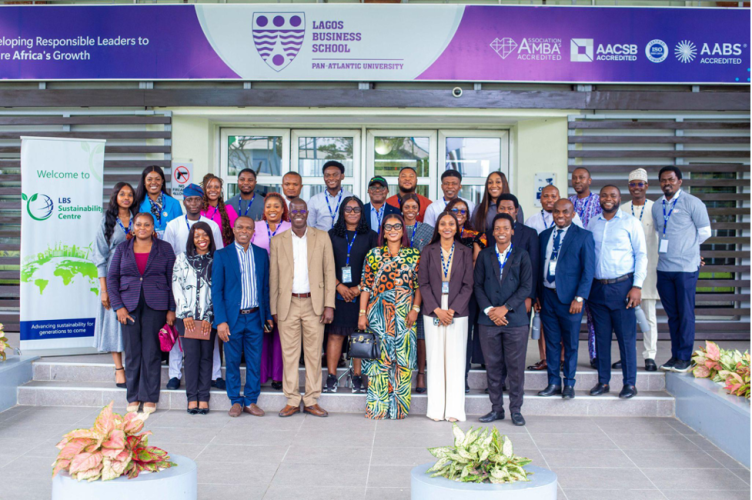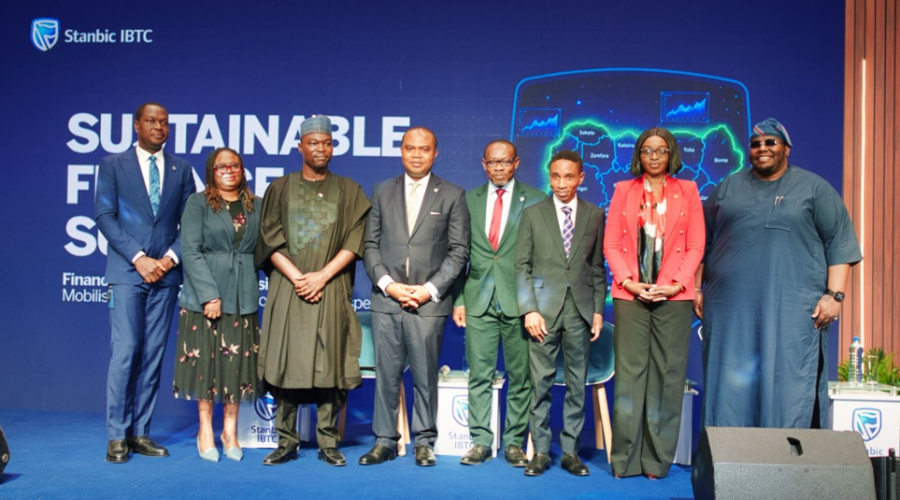
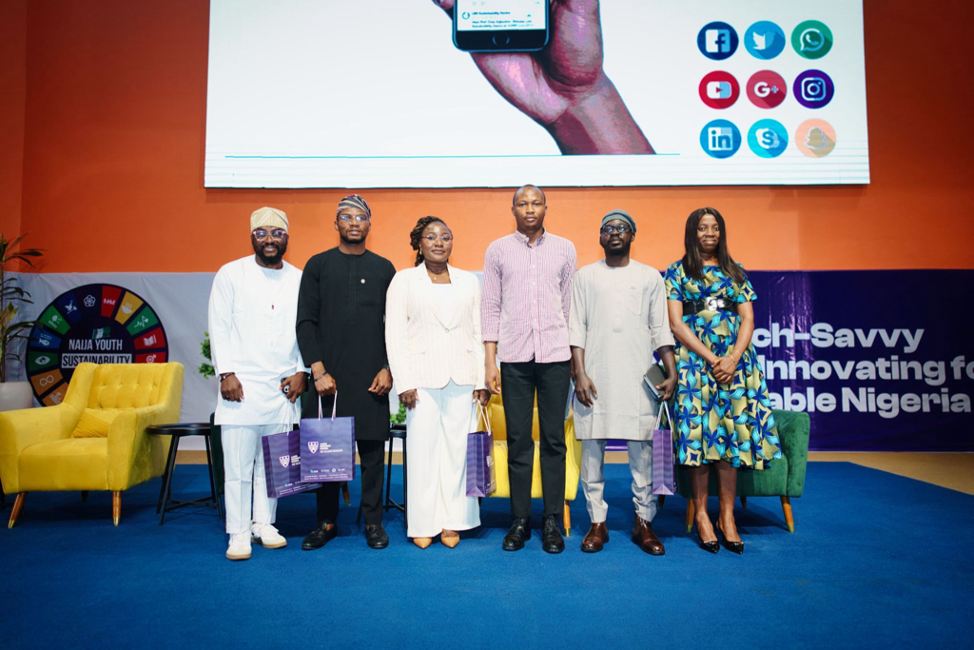
(L–R) Abiodun Shomoye, Senior Manager, Data Analytics and AI Assurance, Deloitte; Olamide Adeyeye, Country Head of Programmes, Jobberman Nigeria; Olawunmi Ajayi, Climate and Sustainability Manager, Bank of Industry; Tomisin Adeyemo, Head of Mobility Operations & Supply, Shuttlers; Tomilola Mustapha, Manager, Africa Retail Academy, Lagos Business School; and Theresa Akpoveso, Manager, Programme Design and Management, Lagos Business School, at the 2026 Naija Youth Sustainability Forum held at Lagos Business School.
The Lagos Business School Sustainability Centre (LBSSC), co-convened the 2026 Naija Youth Sustainability Forum (NYSF) themed “From Tech Savvy to Youth Innovating for a Sustainable Nigeria,” on Saturday, October 3, 2026 with the Nigerian Bottling Company (NBC) as co-convener in Lagos and Abuja. The forum was supported by Union Bank, Jobberman Nigeria, CleanTech Hub, and Youth Employ and Development Initiative. Held simultaneously in Lagos and Abuja, with online participation in both venues, the forum brought together young people, industry leaders, sustainability professionals, technology experts and development practitioners to explore how innovation, entrepreneurship and digital technology can address social and environmental challenges while creating pathways for employment and sustainable economic growth.
In her opening remarks, Mrs Oreva Atanya, Director of the Lagos Business School Sustainability Centre, challenged participants to see themselves as active contributors to Nigeria’s sustainable development journey.
“Today, we gather not just as passive observers of global technological, environmental and socio-economic shifts, but as active architects of innovation, determined to transform Nigeria’s challenges into opportunities for green growth, social inclusion and community empowerment across our nation,” Atanya said. She emphasised the importance of dialogue, collaboration and actionable solutions, encouraging participants to use the forum as a platform for developing ideas capable of creating meaningful impact.
In Lagos, Dr Dumebi Okwechime, Founder and Chief Executive Officer of Izifin, delivered the keynote address, focusing on innovation as a continuous process of learning, experimentation, adaptation and improvement. He encouraged young people to approach challenges with resilience and recognise that meaningful progress often requires persistence, reflection and a willingness to refine their ideas. He said, “Innovation is not a destination; it is a continuous process of learning, experimentation and improvement. Young people must be willing to embrace challenges, learn from setbacks and keep refining their ideas if they want to build solutions that make a lasting difference.”
In Abuja, Mrs Motunrayo Opayinka, Founder and Chief Executive Officer of Womenovate, challenged participants to move beyond having ideas to building solutions that address real problems. She outlined the importance of understanding local contexts, testing ideas, measuring results and developing partnerships that can support implementation and growth. She indicated that “An idea becomes meaningful when it solves a real problem. Young innovators must understand the communities they serve, test their solutions, learn from feedback and build partnerships that help their ideas move from conception to measurable impact.”
The keynote sessions and fireside conversations explored career preparation, experiential learning, personal development and the importance of validating ideas before scaling them. Participants were encouraged to gain practical experience, invest in continuous learning and develop solutions that respond to local needs. A major highlight were the panel discussions titled, “Young Innovation to Drive Green Economic Opportunities: How Can Nigerian Youth Solve Big Problems?” The sessions examined how young Nigerians can apply technology, entrepreneurship and practical skills to address challenges in agriculture, waste management, transportation, energy and climate resilience.
In Lagos, the session was moderated by Tomilola Mustapha, Manager, Africa Retail Academy at Lagos Business School. Panellists included Abiodun Shomoye, Manager, Data Analytics and AI at Deloitte; Olamide Adeyeye, Head of Country Programmes at Jobberman Nigeria; Olawunmi Ajayi, Sustainability and Climate Finance Manager at the Bank of Industry; and Tomisin Adeyemo, Assistant Vice President, Mobility Operations at Shuttlers.
The discussion explored how artificial intelligence and digital tools can connect farmers to markets, improve transport efficiency, strengthen waste management and support climate-related decision-making. Panellists also examined the financing and advisory support required to transform innovative concepts into viable businesses. Speaking to the importance of enterprise development and green financing, Olawunmi Ajayi of the Bank of Industry highlighted the need to connect innovation with business viability and access to appropriate support.“Young people need more than innovative ideas to build sustainable enterprises. Access to finance, sound business models and the right advisory support are equally important in helping them turn solutions into viable opportunities.”
In Abuja, the panel was moderated by Ali Anwar, Sustainability and ESG Specialist, and featured Mojirayo Ogunlana, Executive Director of DigiCivic Initiative; Nneota Egbe of News Central Television; Priscilla Odira Umeakuekwe, Digital Health Informatics Specialist; and Abdulkadir Abdullahi, Founder and Managing Director of Conelli Engineering Limited.
The conversation examined digital rights, advocacy, healthcare access for underserved communities and locally developed responses to infrastructure challenges. Panellists encouraged young people to develop relevant skills, gain practical experience and collaborate, while ensuring that technological progress benefits rural and underserved communities. They also highlighted the importance of including women, young people and marginalised groups in the design and implementation of solutions.
The discussions across both locations reinforced a common message: technology delivers greater value when it is applied to clearly identified problems, supported by effective partnerships and designed around the needs of the people it serves.
The forum also explored the relationship between sustainability, business operations and emerging career opportunities through a session titled “Building Brands, Building Futures: Careers at the Intersection of Commerce and Sustainability.” The session featured representatives of the Nigerian Bottling Company, including Efeyemhen Emore, Packaging Recovery and Sustainability Manager; Simon Enaholo, Supply Chain Continuous Improvement Lead; Stephen Adetunji, Digital Consumer and Customer Platform Lead; and Gbemisola Akinola, Employer Brand Manager. It was moderated by Oreoluwa Adeyinka, Senior Programme Manager at the Lagos Business School Family Business Initiative.
The discussion examined how digital platforms, data analytics, supply chain management, customer experience, packaging recovery and employer branding contribute to business sustainability and create opportunities for young professionals. Participants gained insights into how different business functions can advance sustainability objectives while responding to changing market expectations.
In Lagos, Jobberman Nigeria facilitated a masterclass on employability and career readiness, delivered by Damilola Odubanjo, Senior Consultant, Youth Engagement and Learning. The session focused on communication, problem-solving, adaptability, reliability and digital confidence as important skills for navigating the evolving world of work. In Abuja, Francisca Nwankwo, Head of Operations at CleanTech Hub Nigeria, led a masterclass titled “AI, Digital Technology and the Future of a Sustainable Nigeria,” exploring how emerging technologies can be applied to sustainability challenges and encouraged participants to develop practical skills through projects and collaboration.
The forum also provided a platform for youth-led innovation through the showcase of initiatives such as Wastevest and Plant Together, a tech-enabled platform connecting tree sponsors with verified local tree custodians. The closing sessions delivered by Emmanuel Etaderhi, Senior Vice President at FMDQ Group PLC and Akin Akinbisola, Founder and Executive Director of Youth Employ and Development Initiative, in Lagos and Abuja respectively called on participants to take ownership of their roles in advancing the Sustainable Development Goals (SDGs), and the Africa Agenda 2063, sustain the connections established during the forum, and collaborate to turn ideas into practical solutions.
The 2026 Naija Youth Sustainability Forum highlighted the potential of young Nigerians to contribute meaningfully to sustainable development when equipped with relevant skills, supportive networks and opportunities to innovate. Through conversations on green economic opportunities, employability, inclusive technology and community-based solutions, the forum encouraged participants to move beyond being users of technology to becoming innovators who create lasting value for society.
About Lagos Business School Sustainability Centre
Lagos Business School is Africa’s leading management education institution, and the Lagos Business School Sustainability Centre is a knowledge centre that brings together the theory and practice of business and sustainability to advance performance and development outcomes.
For more information about the initiatives and upcoming events of the Lagos Business School Sustainability Centre, please contact sustainabilitycentre@lbs.edu.ng. For more information on our programmes, visit: https://sustainabilitycentre.lbs.edu.ng/training/
About Nigeria Bottling Company
Nigerian Bottling Company (NBC) is a leading beverage manufacturer in Nigeria and a member of Coca-Cola Hellenic Bottling Company (Coca-Cola HBC). Since its establishment in 1951, NBC has played a significant role in Nigeria’s beverage industry, manufacturing, packaging and distributing a diverse portfolio of beverages. The company is committed to creating value for its stakeholders, supporting socio-economic development and advancing environmental sustainability across its operations.
For more information, visit: https://ng.coca-colahellenic.com/en/